File:QuadraticMapByChatGPTtest11.jpg
Revision as of 09:11, 30 August 2025 by T (talk | contribs) ({{oq|QuadraticMapByChatGPTtest11.jpg|QuadraticMapByChatGPTtest11.jpg (351 × 351 pixels, file size: 100 KB, MIME type: image/jpeg)}} Complex map of function \(z \mapsto z^2 \) in the complex z-plane generated as a test of routine conto01.cin written by ChatGPT 2025.08.29. ==Generator== <pre> #include <stdio.h> #include <stdlib.h> #define DB double #define DO(x,y) for(x=0;x<y;x++) #include<complex> typedef std::complex<double> z_type; #define Re(x) x.real() #define Im(x) x.imag() #d...)
No higher resolution available.
QuadraticMapByChatGPTtest11.jpg (351 × 351 pixels, file size: 100 KB, MIME type: image/jpeg)
Summary
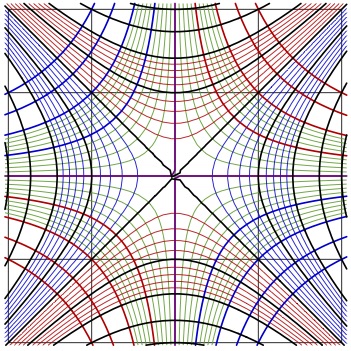
Complex map of function \(z \mapsto z^2 \) in the complex z-plane
generated as a test of routine conto01.cin written by ChatGPT 2025.08.29.
Generator
#include <stdio.h>
#include <stdlib.h>
#define DB double
#define DO(x,y) for(x=0;x<y;x++)
#include<complex>
typedef std::complex<double> z_type;
#define Re(x) x.real()
#define Im(x) x.imag()
#define I z_type(0.,1.)
#include "conto01.cin"
z_type F(z_type z) {return z*z;}
int main(){ int j,k,m,n; DB x,y, p,q, t; z_type z,c,d, cu,cd;
int M=41,M1=M+1;
int N=41,N1=N+1;
DB X[M1],Y[N1]; DB *g, *f, *w; // w is working array.
g=(DB *)malloc((size_t)((M1*N1)*sizeof(DB)));
f=(DB *)malloc((size_t)((M1*N1)*sizeof(DB)));
w=(DB *)malloc((size_t)((M1*N1)*sizeof(DB)));
char v[M1*N1]; // v is working array
FILE *o;o=fopen("QuadraticMapByChatGPTtest11.eps","w");  ado(o,422,422);
fprintf(o,"210 210 translate\n 100 100 scale\n");
fprintf(o,"1 setlinejoin 2 setlinecap\n");
fprintf(o,"/W { setlinewidth } def\n");
fprintf(o,"/RGB { setrgbcolor } def\n");
fprintf(o,"/S { stroke } def\n");
#define M(x,y) fprintf(o,"%6.3f %6.3f M\n",0.+x,0.+y);
#define L(x,y) fprintf(o,"%6.3f %6.3f L\n",0.+x,0.+y);
DO(m,M1) X[m]=-2+.1*(m-.4);
DO(n,N1) Y[n]=-2+.1*(n-.3);
for(m=-2;m<3;m++){M(m,-2) L(m,2)}
for(n=-2;n<3;n++){M(-2,n) L(2,n)}
 fprintf(o,".01 W 0 0 0 RGB S\n");
DO(m,M1)DO(n,N1){      g[m*N1+n]=999;
                       f[m*N1+n]=999;}
DO(m,M1){x=X[m]; if(m/10*10==m) printf("x=%6.3f\n",x);
DO(n,N1){y=Y[n]; z=z_type(x,y); //if(abs(z+2.)>.019)
  c=F(z);
 p=Re(c); q=Im(c); if(p>-99 && p<99 ){ g[m*N1+n]=p;f[m*N1+n]=q;}
       }}
fprintf(o,"1 setlinejoin 1 setlinecap\n"); p=3.;q=2.;
fprintf(o,".01 W 0 .6 0 RGB S\n"); for(m=-2;m<2;m++)for(n=2;n<10;n+=2)conto(o,f,w,v,X,Y,M,N,(m+.1*n),-q,q);
fprintf(o,".01 W .8 0 0 RGB S\n"); for(m=0;m<2;m++) for(n=2;n<10;n+=2)conto(o,g,w,v,X,Y,M,N,-(m+.1*n),-q,q);
fprintf(o,".01 W 0 0 .8 RGB S\n"); for(m=0;m<2;m++) for(n=2;n<10;n+=2)conto(o,g,w,v,X,Y,M,N, (m+.1*n),-q,q);
fprintf(o,".02 W 0 0 .8 RGB S\n"); for(m= 1;m<5;m++) conto(o,f,w,v,X,Y,M,N, (0.-m),-p,p);
fprintf(o,".02 W .8 0 0 RGB S\n"); for(m= 1;m<5;m++) conto(o,f,w,v,X,Y,M,N, (0.+m),-p,p);
fprintf(o,".02 W .5 0 .5 RGB S\n");                   conto(o,f,w,v,X,Y,M,N, (0.  ),-2*p,2*p);
fprintf(o,".02 W 0 0 0 RGB S\n"); for(m=-10;m<11;m++)conto(o,g,w,v,X,Y,M,N,(0.+m),-p,p);
fprintf(o,"showpage\n"); fprintf(o,"%c%cTrailer\n",'%','%');
fclose(o);  free(f); free(g); free(w);
      system("epstopdf QuadraticMapByChatGPTtest11.eps");
      system(    "open QuadraticMapByChatGPTtest11.pdf"); //for macintosh
}
conto01.cin
// conto01.cin
// Safe, small marching-squares contour tracer (drop-in replacement for conto.cin)
// API (keeps compatibility with older mains):
//   void ado(FILE* o, double width, double height);
//   void MM(double x, double y);  // draw small tick/mark at (x,y)
//   void LL(double x, double y);  // draw small tick/mark or label helper
//   double conto(FILE* o, double *field, double *work, char *vis,
//                double *X, double *Y, int M, int N, double level, double vmin, double vmax);
//
// Notes:
// - field is expected as field[m*(N+1) + n], where m in [0..M], n in [0..N] (grid points M+1 by N+1).
// - M,N are cell counts (so there are M+1 and N+1 grid points).
// - This implementation writes multiple short stroked segments. It is robust (bounds-checked).
//
// Usage: include into your main and call ado(o, w,h) to start PostScript, then call conto(...) repeatedly.

#include <cstdio>
#include <cmath>
#include <vector>
#include <string>
#include <cstring>

#ifndef DB
#define DB double
#endif

// PostScript header writer
static FILE* _ps_out = nullptr;
static DB _ps_w = 0, _ps_h = 0;
static bool _ps_started = false;

void ado(FILE* o, double width, double height){
    _ps_out = o;
    _ps_w = width; _ps_h = height;
    _ps_started = true;
    if(!o) return;
    fprintf(o,"%%!PS-Adobe-3.0 EPSF-3.0\n");
    fprintf(o,"%%%%BoundingBox: 0 0 %d %d\n", (int)width, (int)height);
    fprintf(o,"/M { moveto } def\n");
    fprintf(o,"/L { lineto } def\n");
    fprintf(o,"/S { stroke } def\n");
    // small default style
    fprintf(o,"1 setlinejoin 1 setlinecap\n");
    fflush(o);
}

// Small tick helper: draws a tiny line centered at (x,y) in user coords
void MM(double x, double y){
    if(!_ps_out) return;
    double dx = 0.05, dy = 0.05;
    fprintf(_ps_out,"newpath %g %g moveto %g %g lineto stroke\n", x-dx, y, x+dx, y);
}
void LL(double x, double y){
    if(!_ps_out) return;
    double dx = 0.05, dy = 0.05;
    fprintf(_ps_out,"newpath %g %g moveto %g %g lineto stroke\n", x, y-dy, x, y+dy);
}

// Internal helper: write a stroked segment between two points
static inline void _ps_seg(FILE* o, double x1, double y1, double x2, double y2){
    if(!o) return;
    fprintf(o,"newpath %g %g moveto %g %g lineto stroke\n", x1, y1, x2, y2);
}

// Linear interpolation helper
static inline double interp(double a, double b, double va, double vb, double level){
    if (fabs(vb - va) < 1e-18) return (a + b) * 0.5; // degenerate: return midpoint
    return a + (b-a) * ( (level - va) / (vb - va) );
}

// Marching squares lookup: each case yields 0,1, or 2 segments. We'll handle ambiguous cases with center test.
static const int edge_pairs[16][4] = {
    {-1,-1,-1,-1},//0
    {0,3,-1,-1},   //1
    {0,1,-1,-1},   //2
    {1,3,-1,-1},   //3
    {1,2,-1,-1},   //4
    {0,1,2,3},     //5 ambiguous (saddle) -> will be resolved by center test
    {0,2,-1,-1},   //6
    {2,3,-1,-1},   //7
    {2,3,-1,-1},   //8 (mirror)
    {0,2,-1,-1},   //9
    {0,3,1,2},     //10 ambiguous
    {1,2,-1,-1},   //11
    {1,3,-1,-1},   //12
    {0,1,-1,-1},   //13
    {0,3,-1,-1},   //14
    {-1,-1,-1,-1}  //15
};

// Map edge index -> endpoints (in local cell coordinates [0..1])
// edge 0: between (0,0)-(1,0)  bottom
// edge 1: between (1,0)-(1,1)  right
// edge 2: between (1,1)-(0,1)  top
// edge 3: between (0,1)-(0,0)  left
static inline void edge_point(int edge, int i, int j, double* X, double* Y, double* field, int M, int N, double level, double &rx, double &ry){
    // X and Y are grid point arrays of length M+1 and N+1 respectively
    // i in [0..M-1], j in [0..N-1] identifies cell
    int N1 = N + 1;
    double v00 = field[i*N1 + j];
    double v10 = field[(i+1)*N1 + j];
    double v11 = field[(i+1)*N1 + (j+1)];
    double v01 = field[i*N1 + (j+1)];
    if(edge==0){
        double x = interp(X[i], X[i+1], v00, v10, level);
        double y = Y[j];
        rx = x; ry = y; return;
    } else if(edge==1){
        double x = X[i+1];
        double y = interp(Y[j], Y[j+1], v10, v11, level);
        rx = x; ry = y; return;
    } else if(edge==2){
        double x = interp(X[i+1], X[i], v11, v01, level);
        double y = Y[j+1];
        rx = x; ry = y; return;
    } else { // edge==3
        double x = X[i];
        double y = interp(Y[j+1], Y[j], v01, v00, level);
        rx = x; ry = y; return;
    }
}

// Determine center value (for ambiguous cases)
static inline double cell_center_value(int i, int j, double* field, int M, int N){
    int N1 = N + 1;
    double v00 = field[i*N1 + j];
    double v10 = field[(i+1)*N1 + j];
    double v11 = field[(i+1)*N1 + (j+1)];
    double v01 = field[i*N1 + (j+1)];
    return 0.25*(v00+v10+v11+v01);
}

// Main contour function
DB conto(FILE* o, double *field, double *work, char *vis, double *X, double *Y,
         int M, int N, double level, double vmin, double vmax)
{
    // Inputs:
    // field: array length (M+1)*(N+1) indexed as field[m*(N+1) + n]
    if (!o) return 0.0;
    if (!field || !X || !Y) return 0.0;
    int M1 = M + 1, N1 = N + 1;
    // safety checks
    if (M <= 0 || N <= 0) return 0.0;

    // For each cell, evaluate case and emit segment(s)
    for(int i=0;i<M;i++){
        for(int j=0;j<N;j++){
            // read corner values
            double v00 = field[i*N1 + j];
            double v10 = field[(i+1)*N1 + j];
            double v11 = field[(i+1)*N1 + (j+1)];
            double v01 = field[i*N1 + (j+1)];
            int b0 = (v00 > level) ? 1 : 0;
            int b1 = (v10 > level) ? 1 : 0;
            int b2 = (v11 > level) ? 1 : 0;
            int b3 = (v01 > level) ? 1 : 0;
            int idx = b0 | (b1<<1) | (b2<<2) | (b3<<3);

            // no intersection or full cell: skip
            if (idx == 0 || idx == 15) continue;

            // handle ambiguous saddle cases (5 and 10) by center test
            int pairs[4] = {-1,-1,-1,-1};
            if (idx==5 || idx==10){
                double center = cell_center_value(i,j,field,M,N);
                if ( (idx==5 && center > level) || (idx==10 && center <= level) ){
                    // connect as two diagonals (0-1 and 2-3) -> edges [0,1] and [2,3] or [0,3] etc.
                    if(idx==5){
                        pairs[0]=0; pairs[1]=1; pairs[2]=2; pairs[3]=3;
                    } else {
                        pairs[0]=0; pairs[1]=3; pairs[2]=1; pairs[3]=2;
                    }
                } else {
                    // alternate diagonal
                    if(idx==5){
                        pairs[0]=0; pairs[1]=3; pairs[2]=1; pairs[3]=2;
                    } else {
                        pairs[0]=0; pairs[1]=1; pairs[2]=2; pairs[3]=3;
                    }
                }
            } else {
                // use lookup table
                for(int k=0;k<4;k++) pairs[k] = edge_pairs[idx][k];
            }

            // emit segments for each valid pair
            for(int k=0;k<4;k+=2){
                int eA = pairs[k];
                int eB = pairs[k+1];
                if (eA < 0 || eB < 0) break;
                double ax, ay, bx, by;
                edge_point(eA, i, j, X, Y, field, M, N, level, ax, ay);
                edge_point(eB, i, j, X, Y, field, M, N, level, bx, by);
                // safety: coords finite?
                if (!std::isfinite(ax) || !std::isfinite(ay) || !std::isfinite(bx) || !std::isfinite(by)) continue;
                // emit small segment
                _ps_seg(o, ax, ay, bx, by);
            }
        }
    }

    return 1.0;
}
References
Keywords
«ChatGPT», «Conto.cin», «Conto01.cin», «ContoTestQuadraticMap»,
File history
Click on a date/time to view the file as it appeared at that time.
| Date/Time | Thumbnail | Dimensions | User | Comment | |
|---|---|---|---|---|---|
| current | 09:11, 30 August 2025 | | 351 × 351 (100 KB) | T (talk | contribs) | {{oq|QuadraticMapByChatGPTtest11.jpg|QuadraticMapByChatGPTtest11.jpg (351 × 351 pixels, file size: 100 KB, MIME type: image/jpeg)}} Complex map of function \(z \mapsto z^2 \) in the complex z-plane generated as a test of routine conto01.cin written by ChatGPT 2025.08.29. ==Generator== <pre> #include <stdio.h> #include <stdlib.h> #define DB double #define DO(x,y) for(x=0;x<y;x++) #include<complex> typedef std::complex<double> z_type; #define Re(x) x.real() #define Im(x) x.imag() #d... |
You cannot overwrite this file.
File usage
The following 2 pages use this file:
