File:ZexD6mapT100.png
Jump to navigation
Jump to search

Size of this preview: 603 × 599 pixels. Other resolutions: 242 × 240 pixels | 1,717 × 1,706 pixels.
Original file (1,717 × 1,706 pixels, file size: 1.66 MB, MIME type: image/png)
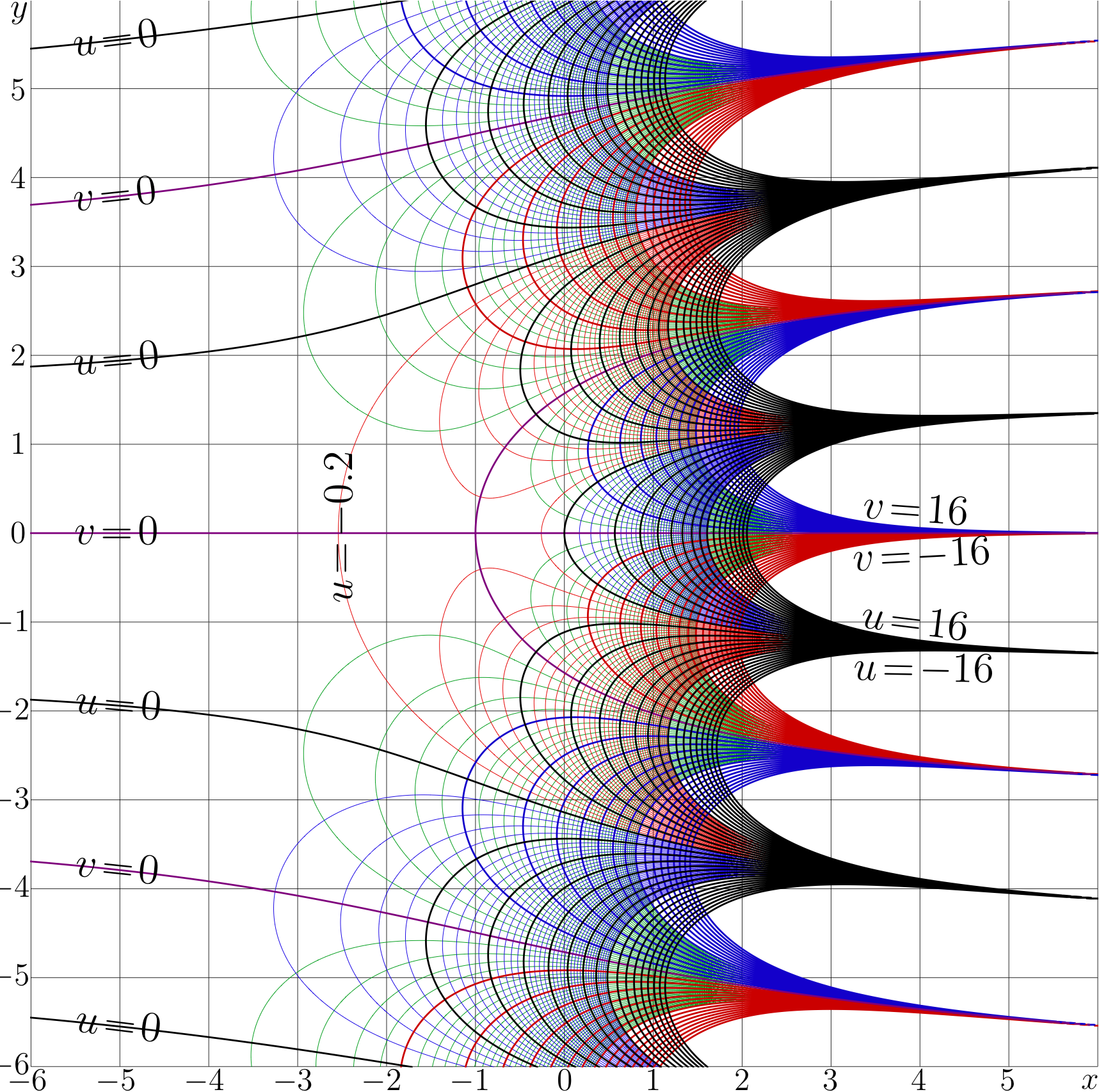
Complex map of function zex \(=\) ArcLambertW,
\mathrm{zex}(z)=z\exp(z) \]
\[ u\!+\!\mathrm i v=\mathrm{zex}(x\!+\!\mathrm i y) \]
This map is used as Fig.11.3 at page 136 of book «Superfunctions», 2020
[1][2]
in order to show the Transfer function considered in Chapter 11 as an example for the exotic iteration.
C++ generator of curves
 #include <math.h>
 #include <stdio.h>
 #include <stdlib.h>
 #define DB double
 #define DO(x,y) for(x=0;x<y;x++)
 using namespace std;
 #include<complex>
 typedef complex<double> z_type;
 #define Re(x) x.real()
 #define Im(x) x.imag()
 #define I z_type(0.,1.)
 #include "conto.cin"
 //#include "fsexp.cin"
 //#include "fslog.cin"

 z_type zex(z_type z){ return z*exp(z);}

 main(){ int j,k,m,n; DB x1,x,y, p,q, t; z_type z,c,d, cu,cd;
 int M=1201,M1=M+1;
 int N=1201,N1=N+1;
 DB X[M1],Y[N1];
 DB *g, *f, *w; // w is working array.
 g=(DB *)malloc((size_t)((M1*N1)*sizeof(DB)));
 f=(DB *)malloc((size_t)((M1*N1)*sizeof(DB)));
 w=(DB *)malloc((size_t)((M1*N1)*sizeof(DB)));
 char v[M1*N1]; // v is working array
 FILE *o;o=fopen("zexD6map.eps","w");  ado(o,1202,1202);
 fprintf(o,"601 601 translate\n 100 100 scale\n");
 fprintf(o,"1 setlinejoin 2 setlinecap\n");
 DO(m,M1) X[m]=-6.+.01*(m-.5);
 DO(n,N1) Y[n]=-6.+.01*(n-.5);
 //for(n=0;n<N1;n++) { Y[n]=0.6*sinh((3./200.)*(n-200.5)); printf("%3d %9.6f\n",n,Y[n]); }
 for(m=-6;m<7;m++) {M(m,-6)L(m,6)}
 for(n=-6;n<7;n++) {M(  -6,n)L(6,n)} fprintf(o,".006 W 0 0 0 RGB S\n");
 DO(m,M1)DO(n,N1){      g[m*N1+n]=999;
                        f[m*N1+n]=999;}
 DO(m,M1){x=X[m]; if(m/10*10==m) printf("x=%6.3f\n",x);
 DO(n,N1){y=Y[n]; z=z_type(x,y);  c=zex(z);  p=Re(c); q=Im(c);
 //        if(p>-19 && p<19 &&  fabs(q)>1.e-12 && fabs(p)>1.e-12)
 g[m*N1+n]=p;
 //        if(p>-19 && p<19 &&  fabs(q)>1.e-12 && fabs(p)>1.e-12)
 f[m*N1+n]=q;
        }}
 fprintf(o,"1 setlinejoin 1 setlinecap\n");  p=20.;q=.3;
 for(m=-8;m<8;m++)for(n=2;n<10;n+=2)conto(o,f,w,v,X,Y,M,N,(m+.1*n),-q,q);fprintf(o,".007 W 0 .6 0 RGB S\n");
 for(m=0;m<8;m++) for(n=2;n<10;n+=2)conto(o,g,w,v,X,Y,M,N,-(m+.1*n),-q,q);fprintf(o,".007 W .9 0 0 RGB S\n");
 for(m=0;m<8;m++) for(n=2;n<10;n+=2)conto(o,g,w,v,X,Y,M,N, (m+.1*n),-q,q);fprintf(o,".007 W 0 0 .9 RGB S\n");
 for(m= 1;m<17;m++) conto(o,f,w,v,X,Y,M,N, (0.-m),-p,p);fprintf(o,".02 W .8 0 0 RGB S\n");
 for(m= 1;m<17;m++) conto(o,f,w,v,X,Y,M,N, (0.+m),-p,p);fprintf(o,".02 W 0 0 .8 RGB S\n");
                conto(o,f,w,v,X,Y,M,N, (0.  ),-p,p); fprintf(o,".02 W .5 0 .5 RGB S\n");
 for(m=-16;m<17;m++)conto(o,g,w,v,X,Y,M,N,(0.+m),-p,p);fprintf(o,".02 W 0 0 0 RGB S\n");
 fprintf(o,"showpage\n");  fprintf(o,"%c%cTrailer\n",'%','%');
 fclose(o);  free(f); free(g); free(w);
       system("epstopdf zexD6map.eps");
       system(    "open zexD6map.pdf"); //for macintosh
       getchar(); system("killall Preview"); // For macintosh
 }
<pre>
==[[Latex]] generator of labels==
% <pre>
\documentclass[12pt]{article} % <br>
\paperheight 1228px %  <br>
\paperwidth 1236px %  <br>
\textwidth 1394px %  <br>
\textheight 1300px %  <br>
\topmargin -104px %  <br>
\oddsidemargin -78px %  <br>
\usepackage{graphics} %  <br>
\usepackage{rotating} %  <br>
\newcommand \sx {\scalebox} %  <br>
\newcommand \rot {\begin{rotate}} %  <br>
\newcommand \ero {\end{rotate}} %  <br>
\newcommand \ing {\includegraphics} %  <br>
\newcommand \rmi {\mathrm{i}} %  <br>
\begin{document} %  <br>
\newcommand \zoomax { %  <br>
\put(18,1206){\sx{3.3}{$y$}} %  <br>
\put(18,1113){\sx{3}{$5$}} %  <br>
\put(18,1013){\sx{3}{$4$}} %  <br>
\put(18, 913){\sx{3}{$3$}} %  <br>
\put(18, 813){\sx{3}{$2$}} %  <br>
\put(18, 713){\sx{3}{$1$}} %  <br>
\put(18, 613){\sx{3}{$0$}} %  <br>
\put(-6, 513){\sx{3}{$-1$}} %  <br>
\put(-6, 413){\sx{3}{$-2$}} %  <br>
\put(-6, 313){\sx{3}{$-3$}} %  <br>
\put(-6, 213){\sx{3}{$-4$}} %  <br>
\put(-6, 113){\sx{3}{$-5$}} %  <br>
\put(-6, 013){\sx{3}{$-6$}} %  <br>
\put(014, -5){\sx{3}{$-6$}} %  <br>
\put(114, -5){\sx{3}{$-5$}} %  <br>
\put(214, -5){\sx{3}{$-4$}} %  <br>
\put(314, -5){\sx{3}{$-3$}} %  <br>
\put(414, -5){\sx{3}{$-2$}} %  <br>
\put(514, -5){\sx{3}{$-1$}} %  <br>
\put(635, -5){\sx{3}{$0$}} %  <br>
\put(735, -5){\sx{3}{$1$}} %  <br>
\put(835, -5){\sx{3}{$2$}} %  <br>
\put(935, -5){\sx{3}{$3$}} %  <br>
\put(1035, -5){\sx{3}{$4$}} %  <br>
\put(1135, -5){\sx{3}{$5$}} %  <br>
\put(1227,-4){\sx{3}{$x$}} %  <br>
} %  <br>
\parindent 0pt %  <br>
\sx{1}{\begin{picture}(1252,1220) % <br>
%\put(40,20){\ing{b271tMap3}} %  <br>
%\put(40,20){\ing{ExpMap}} %  <br>
%\put(40,20){\ing{suzexD1map}} %  <br>
\put(40,20){\ing{ZexD6map}} %  <br>
\zoomax %  <br>
\put(90,1162){\sx{4}{\rot{7}$u\!=\!0$\ero}} %  <br>
\put(90,987){\sx{4}{\rot{6}$v\!=\!0$\ero}} %  <br>
\put(90,802){\sx{4}{\rot{5}$u\!=\!0$\ero}} %  <br>
\put(90,611){\sx{4}{$v\!=\!0$}} %  <br>
\put(404,545){\sx{4}{\rot{90}$u\!=\!-0.2$\ero}} %  <br>
\put(980,641){\sx{4}{\rot{-4}$v\!=\!16$\ero}} %  <br>
\put(970,581){\sx{4}{\rot{3}$v\!=\!-16$\ero}} %  <br>
\put(978,517){\sx{4}{\rot{-7}$u\!=\!16$\ero}} %  <br>
\put(970,458){\sx{4}{\rot{-1}$u\!=\!-16$\ero}} %  <br>
% <br>
\put(90,421){\sx{4}{\rot{-5}$u\!=\!0$\ero}} %  <br>
\put(90,237){\sx{4}{\rot{-6}$v\!=\!0$\ero}} %  <br>
\put(90, 61){\sx{4}{\rot{-7}$u\!=\!0$\ero}} %  <br>
\end{picture}} %  <br>
\end{document} %  <br>
References
- ↑ https://www.amazon.com/Superfunctions-Non-integer-holomorphic-functions-superfunctions/dp/6202672862 Dmitrii Kouznetsov. Superfunctions. Lambert Academic Publishing, 2020. Tools for evaluation of superfunctions, abelfunctions and non-integer iterates of holomorphic functions are collected. For a given transferfunction T, the superfunction is solution F of the transfer equation F(z+1)=T(F(z)) . The abelfunction is inverse of F. In particular, superfunctions of factorial, exp, sin are suggested. The Holomorphic extensions of the logistic sequence and those of the Ackermann functions are considered. Among ackermanns, the tetration (mainly to the base b>1) and natural pentation (to base b=e) are presented. The efficient algorithm for the evaluation of superfunctions and abelfunctions are described. The graphics and complex maps are plotted. The possible applications are discussed. Superfunctions significantly extend the set of functions, that can be used in scientific research and technical design.
- ↑ https://mizugadro.mydns.jp/BOOK/468.pdf Dmitrii Kouznetsov. Superfunctions. Lambert Academic Publishing, 2020.
Keywords
«ArcLambertW», «Exotic iteration», «Exotic iteration», «Fixed point», «LambertW», «Superfunctions», «Transfer function», «Zex»,
«Суперфункции»,
File history
Click on a date/time to view the file as it appeared at that time.
| Date/Time | Thumbnail | Dimensions | User | Comment | |
|---|---|---|---|---|---|
| current | 17:50, 20 June 2013 | | 1,717 × 1,706 (1.66 MB) | Maintenance script (talk | contribs) | Importing image file |
You cannot overwrite this file.
File usage
The following page uses this file:
